Details
DRM: Digitales Wasserzeichen
Weitere Details
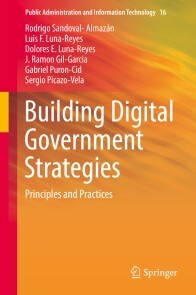
Building Digital Government Strategies
eBook - Principles and Practices, Economics and Finance (R0)
Beschreibung
This book provides key strategic principles and best practices to guide the design and implementation of digital government strategies. It provides a series of recommendations and findings to think about IT applications in government as a platform for information, services and collaboration, and strategies to avoid identified pitfalls. Digital government research suggests that information technologies have the potential to generate immense public value and transform the relationships between governments, citizens, businesses and other stakeholders. However, developing innovative and high impact solutions for citizens hinges on the development of strategic institutional, organizational and technical capabilities. Thus far, particular characteristics and problems of the public sector organization promote the development of poorly integrated and difficult to maintain applications. For example, governments maintain separate applications for open data, transparency, and public services, leading to duplication of efforts and a waste of resources. The costs associated with maintaining such sets of poorly integrated systems may limit the use of resources to future projects and innovation. This book provides best practices and recommendations based on extensive research in both Mexico and the United States on how governments can develop a digital government strategy for creating public value, how to finance digital innovation in the public sector, how to building successful collaboration networks and foster citizen engagement, and how to correctly implement open government projects and open data. It will be of interest to researchers, practitioners, students, and public sector IT professionals that work in the design and implementation of technology-based projects and programs.
Über Rodrigo Sandoval-Almazán, Luis F Luna-Reyes, Dolores E et Luna-Reyes
Rodrigo Sandoval-Almazan is Professor of the School of Accounting and Administration of the Autonomous University of the State of Mexico (UAEM) in Toluca, México. He has been professor of the Graduate School of Public Administration (EGAP) and Business Administration (EGADE) of the Institute of Technology and Superior Studies of Monterrey(ITESM) , Campus Estado de Mexico He is a member of the National Researchers System Level 2 . He has authored or coauthored more than 30 research papers. In 2013 he won the 2nd Latin American Award for Public Administration (INAP). He was the Editor of the Academic Journal RECAI (Journal of Studies on Accounting, Management and Informatics) sponsored by the UAEM. Dr. Sandoval Almazan is a member of NovaGob and somo editorial boards e-government journals. His research interests include e-government, information technology organizations, social networks in government and digital divide.
Luis Felipe Luna-Reyes is an Associate Professor of Informatics at the University at Albany in Albany, NY. He holds a Ph.D. in Information Science from the University at Albany, and he is also a member of the Mexican National Research System. His research focuses on electronic government and on modeling collaboration processes in the development of information technologies across fu
nctional and organizational boundaries. His research interests are related to areas such as inter-organizational collaboration, information sharing, success of government-wide Web sites, and information policy to promote economic exchange in the NAFTA region. He is the author or co-author of articles published in Government Information Quarterly, European Journal of Information Systems, Information Polity, Gestión y Política Pública, and System Dynamics Review, among others.
Dolores E. Luna-Reyes is a Professor in the Industrial, Mechanical and Logistics Engineering Department at Universidad de las Américas Puebla, México. She is member of the National Researchers System. Her research interests include e-government, logistics, and design and analysis of manufacturing systems.
J. Ramon Gil-Garcia, Ph.D., MS is an Associate Professor of Public Administration and Policy and the Research Director of the Center for Technology in Government, University at Albany, State University of New York (SUNY). Dr. Gil-Garcia is a member of the Mexican National System of Researchers and of the Mexican Academy of Sciences. In 2009, he was considered the most prolific author in the field of digital government research worldwid
e and in 2013 he was selected for the Research Award, which is "the highest distinction given annually by the Mexican Academy of Sciences to outstanding young researchers." Dr. Gil-Garcia is the author or co-author of articles in prestigious international journals in Public Administration, Information Systems, and Digital Government and some of hispublications are among the most cited in the field of digital government research worldwide. His research interests include collaborative electronic government, inter-organizational information integration, smart cities and smart governments, adoption and implementation of emergent technologies, digital divide policies, new public management, public policy evaluation, and multi-method research approaches.
Gabriel Puron-Cid is Professor at the Department of Public Administration of the Centro de Investigación y Docencia Económicas, A.C. (CIDE). His areas of research are adoption and impact of technology innovations using data, technology, and analytical methods for policy analysis, performance management and evaluation, public budgeting, and government accounting in the public sector (e-government, open government and open data). His background is multidisciplinary and complementary (accounting, public administration, and in
formation systems). He has a solid formation in public administration theory, practice, and applied analytical and methodological tools bas Quarterly, and in proceedings of different conferences.Inhalt
E-Book Informationen
Alle hier erworbenen E-Books können Sie in Ihrem Kundenkonto in die kostenlose PocketBook Cloud laden. Dadurch haben Sie den Vorteil, dass Sie von Ihrem PocketBook E-Reader, Ihrem Smartphone, Tablet und PC jederzeit auf Ihre gekauften und bereits vorhandenen E-Books Zugriff haben.
Um die PocketBook Cloud zu aktivieren, loggen Sie sich bitte in Ihrem Kundenkonto ein und gehen dort in den Bereich „Downloads“. Setzen Sie hier einen Haken bei „Neue E-Book-Käufe automatisch zu meiner Cloud hinzufügen.“. Dadurch wird ein PocketBook Cloud Konto für Sie angelegt. Die Zugangsdaten sind dabei dieselben wie in diesem Webshop.
Weitere Informationen zur PocketBook Cloud finden Sie unter www.meinpocketbook.de.
Allgemeine E-Book-Informationen
E-Books in diesem Webshop können in den Dateiformaten EPUB und PDF vorliegen und können ggf. mit einem Kopierschutz versehen sein. Sie finden die entsprechenden Informationen in der Detailansicht des jeweiligen Titels.
E-Books ohne Kopierschutz oder mit einem digitalen Wasserzeichen können Sie problemlos auf Ihr Gerät übertragen. Sie müssen lediglich die Kompatibilität mit Ihrem Gerät prüfen.
Um E-Books, die mit Adobe DRM geschützt sind, auf Ihr Lesegerät zu übertragen, benötigen Sie zusätzlich eine Adobe ID und die kostenlose Software Adobe® Digital Editions, wo Sie Ihre Adobe ID hinterlegen müssen. Beim Herunterladen eines mit Adobe DRM geschützten E-Books erhalten Sie zunächst eine .acsm-Datei, die Sie in Adobe® Digital Editions öffnen müssen. Durch diesen Prozess wird das E-Book mit Ihrer Adobe-ID verknüpft und in Adobe® Digital Editions geöffnet.
Bei E-Books die mit Readium LCP geschützt sind erscheint bei dem ersten Öffnen auf ihrem Reader ein Hinweisfenster mit der Aufforderung ein Passwort einzugeben. Gleichzeitig öffnet sich ein Infofeld in dem das Passwort steht. Tragen Sie dieses Passwort in das Eingabefeld ein und bestätigen Sie die Eingabe. Danach öffnet sich das E-Book automatisch. Um E-Books die mit Readium LCP geschützt sind auf einem Tablet/Laptop/Smartphone lesen zu können, benötigen Sie ein Programm, das in der Lage ist, mit diesem Kopierschutz umzugehen. Das ist z.B. der Thorium Reader (Windows, Mac, Linux) oder die PocketBook App (iOS, Android). Fügen Sie das heruntergeladene E-Book in das Programm ein. Bei dem ersten Öffnen erscheint ein Hinweisfenster mit der Aufforderung ein Passwort einzugeben. Gleichzeitig öffnet sich ein Infofeld in dem das Passwort steht. Tragen Sie dieses Passwort in das Eingabefeld ein und bestätigen Sie die Eingabe. Danach öffnet sich das E-Book automatisch.