
Details
DRM: Digitales Wasserzeichen
Weitere Details
1. Auflage 2006
17.01.2006
English
218 S., 5.45 MB
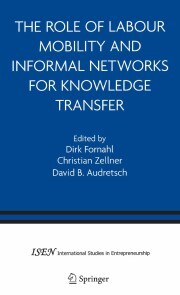
The Role of Labour Mobility and Informal Networks for Knowledge Transfer
eBook - Business and Management (R0)
Beschreibung
The purpose of this volume is to analyze the microfoundations of knowledge spillovers. The microeconomic analysis of spillovers leads to the insight that the spillover and flow of knowledge is not at all automatic. Instead, this volume suggests that a filter exists between knowledge and its economic application. The focus of this volume is on several key mechanisms that serve to reduce this filter and facilitate the flow of knowledge. In particular, the volume draws on an emerging literature identifying the role of knowledge spillovers to investigate significance of labor mobility and informal networks as mechanisms facilitating the flow of knowledge.
No field in economics has dealt extensively with the microeconomics of knowledge spillovers. This volume brings together scholars from a broad spectrum of fields including labor economics, regional economics, the economics of innovation and technological change, and sociology to introduce new insights yielded from the microfoundations of knowledge spillovers.
Über Dirk Fornahl, Christian Zellner, David B Audretsch
Dirk Fornahl studied economics and business administration at the University of Hannover (Germany), at the Dublin City University (Dublin, Ireland) and at the University of California (Berkeley, USA) with a focus on Economic Policy, Environmental Economics and Systems Management, and Labour Economics. Since 1999 Research Associate at the Max Planck Institute for Research into Economic Systems, Evolutionary Economics Group. From June 1999 until May 2001 working in the 'InnoRegio' programme of the Federal Ministry of Education and Science.
Christian Zellner studied development economics at the University of Kent and the University of Cambridge (United Kingdom). He has worked as a Research Associate in the Evolutionary Economics Group at the Max Planck Institute for Research into Economic Systems (Germany) since 2000. His research mainly focuses on the formation of human capital and embodied knowledge transfers. He received his Ph.D. from the Friedrich Schiller University Jena in 2003 for a thesis on the effects of basic research on the dynamics of the innovation process.
David B. Audretsch is the Director of the Research Unit on Entrepreneurship, Growth and Public Policy at the Max Planck Institute for Research into Economics Systems in Germany and a Research Fellow of the Centre for Economic Policy Research (London). He also serves as the Ameritech Chair of Economic Development at Indiana University. Audretsch's research has focused on the links between entrepreneurship, government policy, innovation, economic development and global competitiveness. He has consulted with the World Bank, National Academy of Sciences, U.S. State Department, United States Federal Trade Commission, General Accounting Office and International Trade Commission as well as the United Nations, Commission of the European Union, the European Parliament, the OECD, as well as numerous private corporations, state governments, and a number of European Governments. He is a member of the Advisory Board to a number of international research and policy institutes, including the Zentrum fuer Europaeisch Wirtschaftsforschung (ZEW, Centre for Economic Research), Mannheim, the Hamburgisches Welt-Wirtschafts-Archiv (HWWA, Hamburg Institute of International Economics), the Swedish Foundation for Research on Entrepreneurship and Small Business, and the American Institute for Contemporary German Studies (AICGS), Washington, D.C. His research has been published in over one hundred scholarly articles in the leading academic journals. He has published thirty books including, Innovation and Industry Evolution, with MIT Press. He is co-founder and co-editor of Small Business Economics: An International Journal. He was awarded the 2001 International Award for Entrepreneurship and Small Business Research by the Swedish Foundation for Small Business Research.
Inhalt
E-Book Informationen
Alle hier erworbenen E-Books können Sie in Ihrem Kundenkonto in die kostenlose PocketBook Cloud laden. Dadurch haben Sie den Vorteil, dass Sie von Ihrem PocketBook E-Reader, Ihrem Smartphone, Tablet und PC jederzeit auf Ihre gekauften und bereits vorhandenen E-Books Zugriff haben.
Um die PocketBook Cloud zu aktivieren, loggen Sie sich bitte in Ihrem Kundenkonto ein und gehen dort in den Bereich „Downloads“. Setzen Sie hier einen Haken bei „Neue E-Book-Käufe automatisch zu meiner Cloud hinzufügen.“. Dadurch wird ein PocketBook Cloud Konto für Sie angelegt. Die Zugangsdaten sind dabei dieselben wie in diesem Webshop.
Weitere Informationen zur PocketBook Cloud finden Sie unter www.meinpocketbook.de.
Allgemeine E-Book-Informationen
E-Books in diesem Webshop können in den Dateiformaten EPUB und PDF vorliegen und können ggf. mit einem Kopierschutz versehen sein. Sie finden die entsprechenden Informationen in der Detailansicht des jeweiligen Titels.
E-Books ohne Kopierschutz oder mit einem digitalen Wasserzeichen können Sie problemlos auf Ihr Gerät übertragen. Sie müssen lediglich die Kompatibilität mit Ihrem Gerät prüfen.
Um E-Books, die mit Adobe DRM geschützt sind, auf Ihr Lesegerät zu übertragen, benötigen Sie zusätzlich eine Adobe ID und die kostenlose Software Adobe® Digital Editions, wo Sie Ihre Adobe ID hinterlegen müssen. Beim Herunterladen eines mit Adobe DRM geschützten E-Books erhalten Sie zunächst eine .acsm-Datei, die Sie in Adobe® Digital Editions öffnen müssen. Durch diesen Prozess wird das E-Book mit Ihrer Adobe-ID verknüpft und in Adobe® Digital Editions geöffnet.
Bei E-Books die mit Readium LCP geschützt sind erscheint bei dem ersten Öffnen auf ihrem Reader ein Hinweisfenster mit der Aufforderung ein Passwort einzugeben. Gleichzeitig öffnet sich ein Infofeld in dem das Passwort steht. Tragen Sie dieses Passwort in das Eingabefeld ein und bestätigen Sie die Eingabe. Danach öffnet sich das E-Book automatisch. Um E-Books die mit Readium LCP geschützt sind auf einem Tablet/Laptop/Smartphone lesen zu können, benötigen Sie ein Programm, das in der Lage ist, mit diesem Kopierschutz umzugehen. Das ist z.B. der Thorium Reader (Windows, Mac, Linux) oder die PocketBook App (iOS, Android). Fügen Sie das heruntergeladene E-Book in das Programm ein. Bei dem ersten Öffnen erscheint ein Hinweisfenster mit der Aufforderung ein Passwort einzugeben. Gleichzeitig öffnet sich ein Infofeld in dem das Passwort steht. Tragen Sie dieses Passwort in das Eingabefeld ein und bestätigen Sie die Eingabe. Danach öffnet sich das E-Book automatisch.